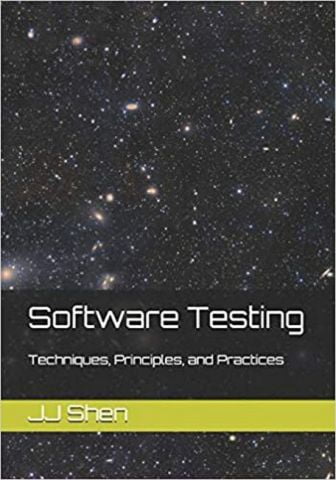
Software Testing. Techniques, Principles, and Practices. Paperback
Зареєструйтесь або увійдіть, щоб додавати книги до списків
Зареєструйтесь або увійдіть, щоб отримувати сповіщення про наявність
Зареєструйтесь або увійдіть, щоб вести читацький щоденник
A groundbreaking, example driven, and practical oriented approach to software testing techniques and principles.
This book offers a unique approach to learning software application testing, appropriate for students in computer sciences and related fields, quality engineers and software developers.In this book, software test cases are formally defined, software testing techniques are presented, and crucial strategies, principles, and practices one can follow in real life scenarios are discussed. The author tries to present simple and clear concepts, and then systematically advance from basic concepts to testing techniques and principles with abundant examples in order to help the readers to understand the theories, techniques, and principles easily. The common techniques that are most useful in practice based on industry experiences are discussed in this book. The main techniques discussed extensively are equivalence partitions, combinatorial testing, decision table testing, and various structural testing techniques. Basic testing principles and regression testing are covered in part 3 of the book, with two case studies to apply some of the basic techniques and principles discussed in the book. Performance testing is also covered in great details with three real life case studies. The author also defined test cases and types of testing in a new original and fundamental way which are never published anywhere else. This book is targeted mainly to software quality engineers but should be valuable to software developers and other IT personals.
The book is written in a textbook style, and there are also numerous exercise problems at the end of most chapters, especially the ones on testing techniques, and it's designed to be used as a reference or a textbook to students who are taking classes in software testing related subjects.
From the Author
There are two ways to learn software testing techniques and principles, one is from attending a software testing class, and the other is from experiences as a quality engineer or a software developer. There is a disconnect between these two. The materials covered in a software testing class and most of the textbooks being used are more academic than practical in a way that emphasizes on theoretical aspects of the techniques rather than on the effectiveness on a real job, and the depth of coverage of certain techniques are not correlated with the usefulness in the real world. While most quality engineers learn certain practical testing techniques on the job but have little formal training on them.
This book is an attempt to bridge the gap. This book is written in a textbook style, and the testing techniques are presented with mathematical theories, but most importantly, numerous practical examples are presented with the theories, and the depth of each technique covered is in line with its usage in the software industry based on experiences. Some aspects of the coverage are original works and are not published anywhere else. Also, two major case studies based on industry experiences are included in the book. Performance testing is also covered with a case study. The book includes 46 examples, 3 case studies, 45 figures, 106 tables, and 35 Java code samples.
Another attempt with the book is to formally define test cases and to classify software testing in a fundamental way into four types. The first two chapters are must read, these two chapters also pave the way to understand the basic principles covered in part three of the book. The basic principles are presented based on real world industrial experiences as well.
About the Author
The author has over twenty years of experiences with various software companies in Silicon Valley, from startups to well-known established ones. In particular, the author has extensive experiences in software test automation including building test automation frameworks, and in leading quality engineering projects, for both consumer and enterprise software applications. The author also has several years of software development experiences early in his career in the software industry.
The author conducted academic research in radio astronomy particularly in studying molecular clouds in close by galaxies before entering the software industry and was also involved in designing astronomical spectrometers at an observatory.
The author's background in both physical sciences and computer sciences and extensive software industry experiences make the book refreshing and unique.
The author holds a MS degree in Computer Sciences from the University of Illinois at Urbana-Champaign, a MS degree in Astronomy (a byproduct of an unfinished PhD program) from the University of Illinois at Urbana-Champaign, a MS degree in Astrophysics from the Chinese Academy of Sciences, and a BS degree in Physics from Hebei University.










Коментарі
Немає коментарів. Будьте першим, хто залишить коментар!